

Want to know what a service level agreement (SLA) is, and looking for free templates? This article explains what an SLA is and why it matters, and offers a useful collection of service level agreement templates in MS Word and PDF formats.
The collection includes 21 free service level agreement templates in Word and PDF for IT support, technical help desks, website development, marketing, recruitment, HR, healthcare, suppliers, government departments and customer services. Every SLA template comes with a preview and a free download button, so service providers and clients can quickly define service scope, response and resolution times, uptime targets, performance metrics and penalties in a clear, professional agreement.
What is a Service Level Agreement?
A service level agreement (SLA) is a legally binding agreement between a service provider and a service user or customer. The basic purpose of such an agreement is to ensure quality services provided by the vendors. By entering into this type of agreement, the service provider retains its credibility and ensures the provision of high-quality services to its customers.
A service level agreement can be used both as a standalone agreement or as a part of an agreement. Whatever the case might be, it is a legally enforceable contract between two or more parties. The presence of a service level agreement protects the interests of all the parties involved in the agreement. The contents of an SLA may vary depending upon the service provider, the customer, or the industry.
Scroll down and check out some professional service level agreement templates and samples provided here on this page.
Check Service Level Agreement Templates in WORD Below
IT Department Service Level Agreement Template

File Size: 74 KB
Government Service Level Agreement Template in WORD

File Size: 66 KB
High Profile Service Level Agreement Template

File Size: 91 KB
Service Level Agreement Template in DOC Format

File Size: 44 KB
Customer Service Level Agreement Template

File Size: 19 KB
Official Service Level Agreement Template
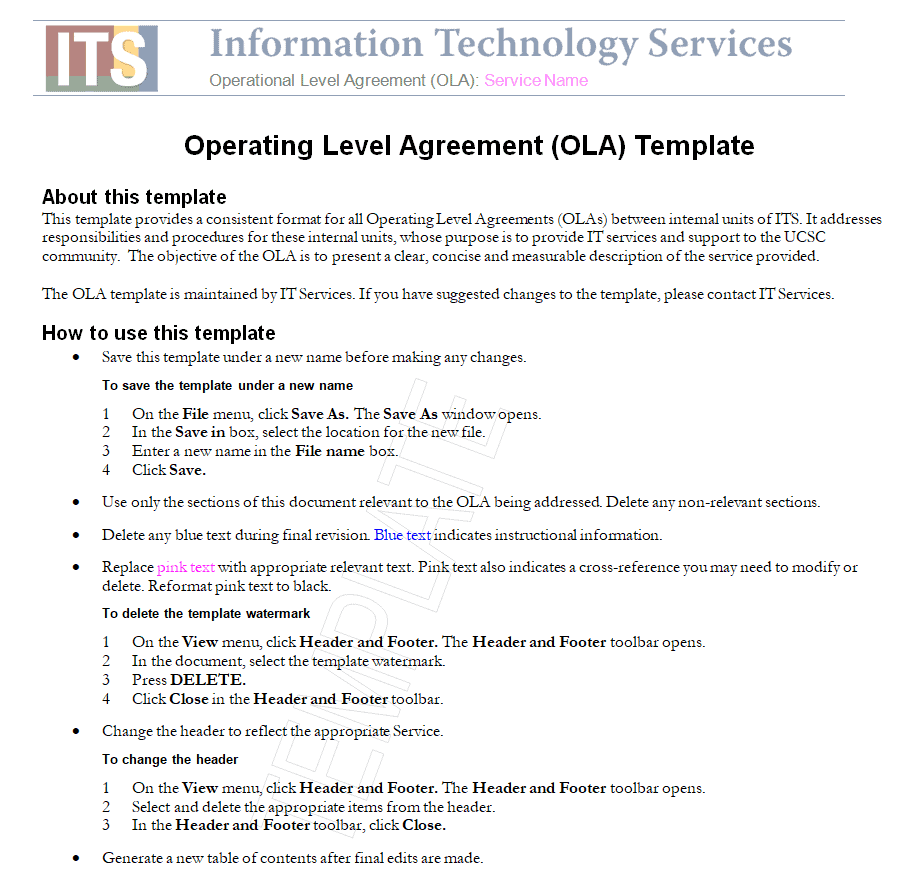
File Size: 100 KB
Example Service Level Agreement Template

File Size: 31 KB
Business Service Level Agreement Sample DOC

File Size: 36 KB
Formal Service Level Agreement Template

File Size: 66 KB
Organization’s Service Level Agreement Template

File Size: 19 KB
Types of Service Level Agreements
There are mainly three most common types of service level agreements. These are:
1. Internal service level agreement:Internal service level agreements are created only for the organization’s internal parties or internal stakeholders. This could be a department requiring services from another department within the same organization. There might not be much need for this agreement but large organizations prefer using the internal service level agreements whenever a department requires the services of another department. This is to ensure consistency and proper record keeping.
2. Customer service level agreement:As the name suggests, a customer service level agreement is the one that is used in case the services are provided to someone outside the organization i.e., customer or client. This type of agreement ensures the provision of a specific level of services to the customer in the return for some consideration, usually a sum of money. As mentioned earlier, this is important to protect the interests of all parties involved in any such agreement.
3. Multilevel service level agreement:Multilevel service level agreements involve the provision of services at different levels. Such types of agreements can be used to provide services both to the customers and the internal departments of the organization. Multilevel SLAs can be used at corporate, customer, and service levels.
- Service level: At the service level, the agreement involves the aspects that can be attributed to a particular service relevant to a specific group of customers.
- Customer level: This includes the provision of services to different groups of customers. For example, a company would require more security for one of its departments as compared to other departments. In this type of agreement, different services are required to be provided to a customer at different levels.
- Corporate level: In this type of multilevel SLA, all the aspects of the agreement are discussed and applied to all customers of the client organization. The aspects of this type of SLA are not subject to immediate or frequent changes, they are not required to be updated often.
Examples of Service Level Agreements
If you are still confused or do not fully understand the concept of a service level agreement, the following examples will help you understand this easily:
- HR Service Level Agreement: As it is obvious from the name, an HR SLA is used by the HR of an organization. For example, the HR department of an organization might require an SLA to explain the services they provide and the quality of their services.
- Maintenance Service Level Agreement: Used by a company or an agency providing maintenance services to clients or customers. Along with other details, this agreement usually includes the scope of the service provider’s work, duration, amount of fee, response time, etc.
- Security Service Level Agreement: Most commonly used by security agencies or companies. This agreement typically includes the specific areas that require more security, the scope of work, or the method of providing the security (usually provided with cloud computing servers).
- Training Service Level Agreement: As the name suggests, training SLA is used by training consultants or training agencies. This includes the type of training to be provided, the duration, the amount of fee, the department of the client organization to whom such training be provided, and many other details.
- Marketing Service Level Agreement: This type of SLA is used by marketing or advertising organization that provides promotional or marketing services to their clients.
Check Service Level Agreement Templates in PDF Below
Technical Support Service Level Agreement Template

File Size: 117 KB
Recruitment Service Level Agreement Template Printable

File Size: 122 KB
Service Level Agreement Template for Nursing

File Size: 203 KB
Website Development Service Level Agreement Example

File Size: 184 KB
University HR Department Service Level Agreement Sample

File Size: 209 KB
Simple Service Level Agreement Draft Document

File Size: 205 KB
Business Service Level Agreement Template PDF

File Size: 190 KB
Professional Service Level Agreement Template

File Size: 207 KB
Supplier’s Quality Service Level Agreement Template

File Size: 733 KB
Sample Service Level Agreement Format

File Size: 256 KB
Marketing and Communications Service Level Agreement Template

File Size: 174 KB
Key Components of a Service Level Agreement
A strong SLA leaves no room for confusion about what will be delivered and how success will be measured. Make sure your service level agreement covers these components:
Agreement overview: The parties involved, the start date, the length of the agreement, and a short summary of its purpose.
Scope of services: A clear description of the services included and, just as important, what is excluded.
Service levels and performance metrics: Measurable targets such as system uptime (for example 99.9%), first response time, resolution time, ticket backlog, accuracy rate, or customer satisfaction score.
Priority levels and escalation: How issues are classified (critical, high, medium, low), the response time for each level, and who to contact when targets are missed.
Responsibilities of both parties: What the service provider must do and what the customer must provide, such as access, information, or timely approvals.
Monitoring and reporting: How performance will be measured, which tools are used, and how often reports are shared. Many teams use a weekly status report or monthly report for this.
Penalties, service credits, and remedies: What happens when service levels are not met, such as fee reductions or the right to terminate.
Review, change, and termination terms: How often the SLA is reviewed, how changes are approved, and how either party can end the agreement.
How to Write an Effective SLA
Start with the customer’s needs: Talk to the users of the service to understand what matters most to them, such as speed, availability, or quality, before setting targets.
Set realistic, measurable targets: Use specific numbers that you can track. “Respond to critical tickets within 1 hour” is better than “respond quickly”.
Document processes: Link the SLA to your standard operating procedures (SOPs) so your team knows exactly how to meet each service level.
Agree on it together: Review the draft with the client, discuss it in a meeting, and record decisions in your meeting minutes before both parties sign.
Review it regularly: Business needs change, so revisit your SLA every six or twelve months and update targets where necessary.
Frequently Asked Questions (FAQs) About Service Level Agreements
What is a service level agreement (SLA)?
A service level agreement is a contract between a service provider and a customer, or between departments, that defines the services to be provided, the expected level of performance, how it will be measured, and what happens if targets are not met.
What are the three types of SLAs?
The three main types are customer-based SLAs (for a single customer), service-based SLAs (one service for all customers), and multilevel SLAs (covering corporate, customer, and service levels in one document). Internal SLAs between departments are also common.
What is the difference between an SLA and a contract?
A contract covers the overall business relationship, including price and legal terms, while an SLA focuses on measurable service performance. An SLA is often attached to, or part of, a larger master service agreement.
What are common SLA metrics?
Common metrics include uptime or availability, first response time, mean time to resolution, first-call resolution rate, error rate, and customer satisfaction score.
What happens if an SLA is breached?
Depending on the agreement, the provider may owe service credits or fee reductions, must submit a corrective action plan, and repeated breaches may allow the customer to end the contract.
Are these SLA templates free?
Yes. All 21 service level agreement templates on this page are free to download and edit in Word or PDF format.
Conclusion
A clear service level agreement builds trust between service providers and customers by setting measurable expectations from day one. With these 21 free SLA templates in Word and PDF, you can quickly create agreements for IT support, technical services, HR, marketing, suppliers, and customer service. Choose a template, define your services and performance targets, agree on reporting and remedies, and sign it with your client or internal team. For larger projects, pair your SLA with a project charter that sets out the overall goals and scope.
