A last will and testament lets you decide who receives your property, who manages your estate and who cares for your minor children. On this page you can download 9 free last will and testament templates in Word and PDF, including a last will and testament form, simple will templates and printable blank will forms. Each template gives you a clear structure for naming an executor, listing beneficiaries and gifts, appointing a guardian and signing in front of witnesses. Laws differ from place to place, so review your finished will with a local attorney before relying on it.
Last Will and Testament Basics
A last will and testament is a legal document that explains how your property, assets and money should be distributed after your death. Writing a will is an important part of estate planning because it makes things easier for your loved ones and helps prevent family disputes. It lets you control who inherits your home, savings, investments and personal belongings, and who will carry out your wishes.
What a will usually covers: Your personal details, the appointment of an executor, the names of your beneficiaries and what each will receive, a guardian for minor children, any gifts to charities or nonprofit organizations, and the signatures of you and your witnesses. Some people leave their whole estate to family members in equal shares, while others include friends or charitable trusts.
Make sure it is valid: The person making the will must follow the legal requirements of their state or country, such as age, mental capacity, signing and witness rules, for the document to be accepted. A family lawyer can review your draft and confirm it meets local law.
Why use a template: A free will template gives you a clear starting point and a logical order for every section, so you can write a clear and concise will yourself and spend less on legal fees.
How to use these templates: Download a last will template, read every section carefully and fill in your full legal name, executor, beneficiaries and specific gifts. Sign the will in front of the required number of witnesses, store the original in a safe place and tell your executor where to find it. Review your will after major life events such as marriage, divorce, the birth of a child or buying property.
Download Last Will and Testament Templates
Compare the previews below and choose a layout that fits your task. Each download shows its actual file format. Choose from seven Word documents and two PDFs. Word files can be edited in compatible software; check PDFs for fillable fields before completing or printing them.
1. Last will and testament form (DOC)
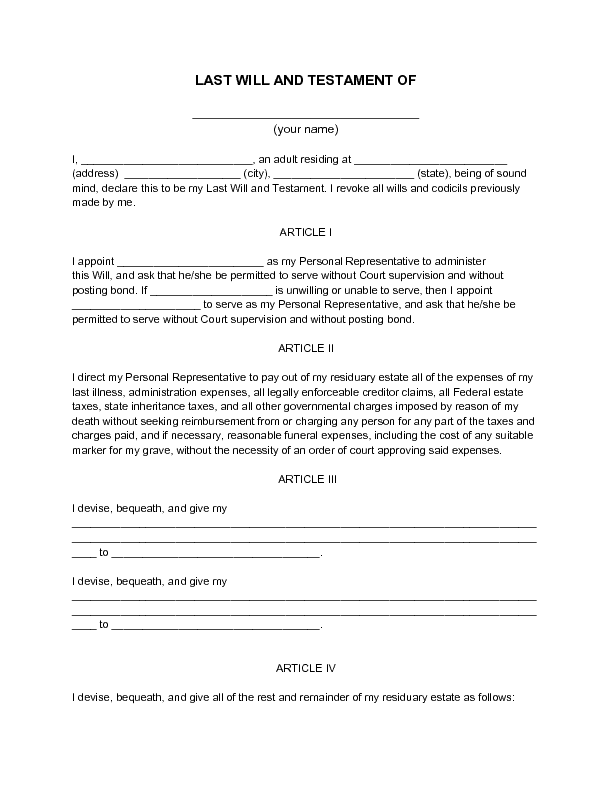
Download last will and testament template 1 — Word (DOC)
2. Last will and testament template in Word (DOC)
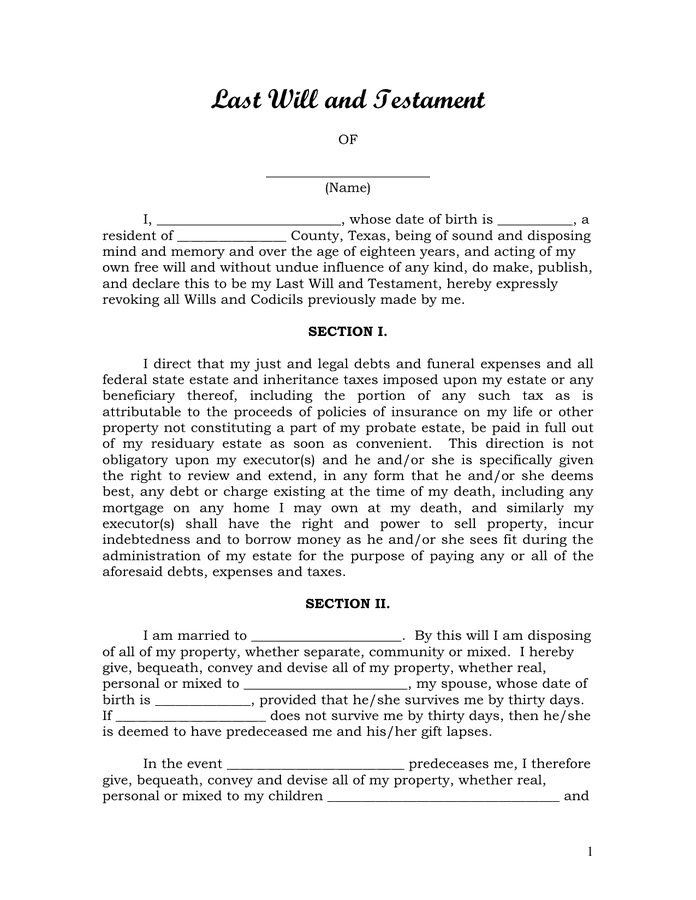
Download last will and testament template 2 — Word (DOC)
3. Simple last will and testament template (DOCX)
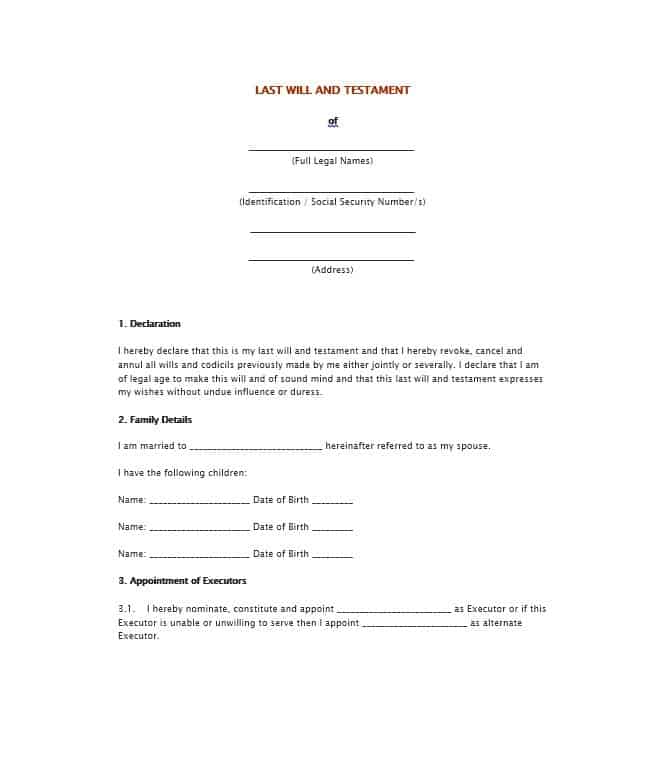
Download last will and testament template 3 — Word (DOCX)
4. Printable last will template (DOC)
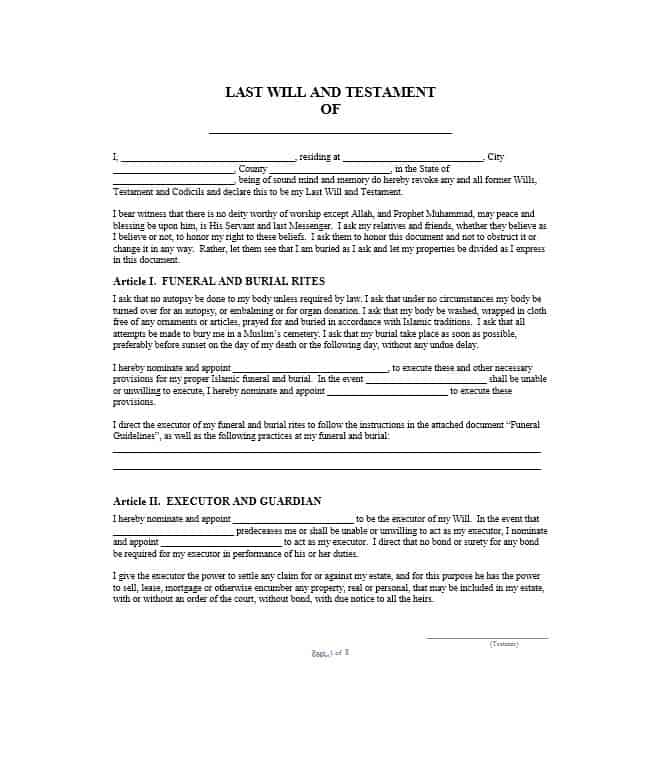
Download last will and testament template 4 — Word (DOC)
5. Blank last will and testament form (DOC)
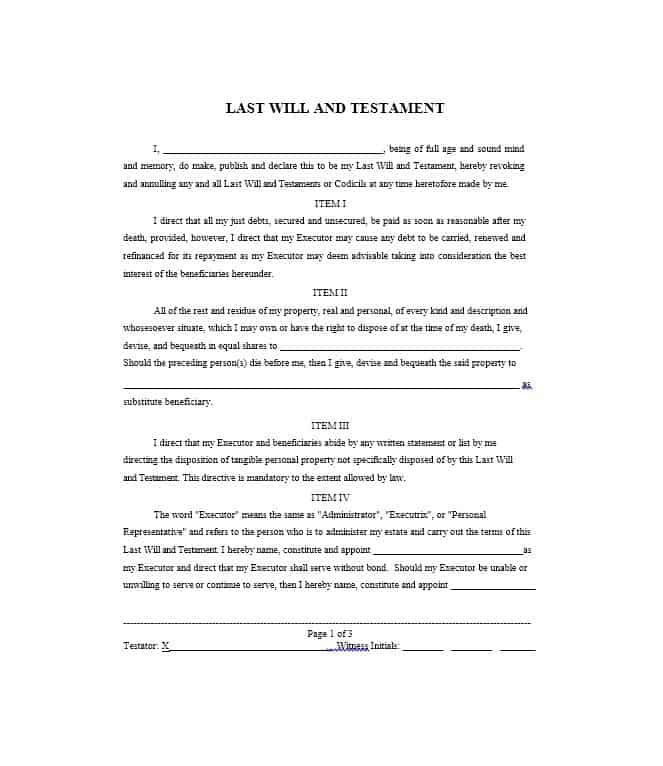
Download last will and testament template 5 — Word (DOC)
6. Last will and testament sample (DOCX)
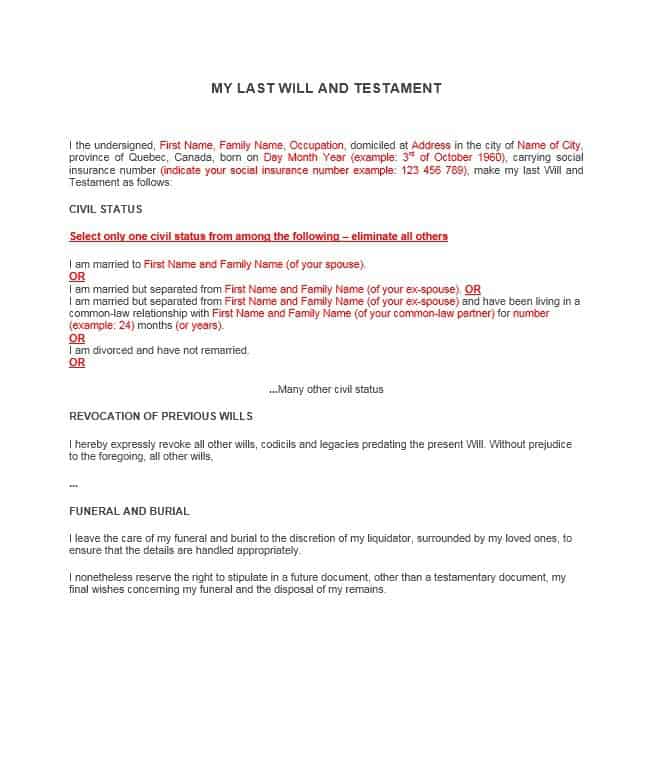
Download last will and testament template 6 — Word (DOCX)
7. Will template for estate planning (DOC)
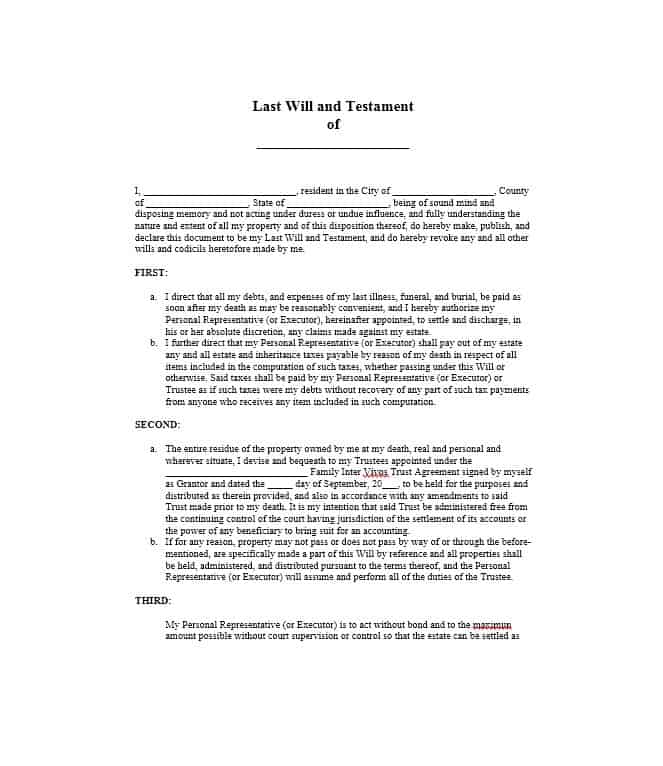
Download last will and testament template 7 — Word (DOC)
8. Last will and testament template PDF (PDF)
Download last will and testament template 8 — PDF (PDF)
9. Printable will form PDF (PDF)

Download last will and testament template 9 — PDF (PDF)
What Is a Last Will and Testament?
A last will and testament is a legal document in which a person, called the testator, explains how their property and belongings should be distributed after death. A will can also name an executor to manage the estate, appoint a guardian for minor children, leave gifts to friends or charities, and give instructions about debts and taxes. Without a valid will, the law of your state or country decides who inherits your estate, which may not match your wishes and can create delays and stress for your family.
Using a last will and testament template is a practical way to organize your wishes and prepare a first draft. Simple estates can often be handled with a well-prepared will, while larger or more complicated estates usually benefit from professional legal advice.
Key Parts of a Last Will and Testament
Declaration: A statement that this is your last will, that you are of legal age and sound mind, and that it revokes all earlier wills and codicils.
Personal information: Your full legal name, address and, if you wish, details of your spouse and children.
Executor appointment: The person you trust to carry out the will, pay debts, file final tax returns and distribute assets, plus an alternate executor in case the first choice cannot serve.
Guardian for minor children: The person who will care for your children if both parents die, and an alternate guardian.
Beneficiaries and specific gifts: Who receives particular items, such as a house, car, jewelry, savings or family heirlooms, and any gifts to charities.
Residuary clause: Who receives everything that is not specifically mentioned elsewhere in the will. This clause prevents assets from being left out.
Debts, taxes and expenses: Instructions for paying funeral costs, outstanding debts and estate taxes.
Signatures and witnesses: Your signature and date, and the signatures of the required number of witnesses. Some places also allow or require a notary or a self-proving affidavit.
How to Write a Will Using a Template
1. List your assets and debts: Make an inventory of property, bank accounts, investments, insurance policies, vehicles, valuable items and debts. Note which assets already pass by beneficiary designation or joint ownership.
2. Decide on beneficiaries: Choose who should receive each asset and what share of the remaining estate each person should get.
3. Choose an executor and guardian: Ask the people you plan to name whether they are willing to serve.
4. Fill in the template: Download a last will and testament template from this page, open it in Word or as a PDF, and replace the sample text with your details. Keep the wording clear and avoid ambiguous phrases.
5. Sign correctly: Sign the will in front of the witnesses required by your local law. Witnesses should usually be adults who are not beneficiaries.
6. Store it safely: Keep the original in a fireproof safe, with your lawyer or in an official will registry, and tell your executor where it is. Many families store a note about the will’s location with their family emergency plan.
Tips for a Valid and Effective Will
Legal requirements for wills differ between countries and states, especially regarding witnesses, notarization and handwritten wills, so check your local rules or ask an estate planning attorney to review your draft. Review your will after major life events such as marriage, divorce, the birth of a child, the death of a beneficiary or buying property. To change a will, either write a new one or add a properly signed codicil rather than crossing out text. Keep a separate, up-to-date list of accounts and important contacts in a record book, and use a checklist to make sure all estate planning documents, such as a power of attorney and healthcare directive, are complete. If you prefer a formal look for related documents, you can print them on a personal letterhead.
Common Will-Writing Mistakes to Avoid
Not signing correctly: A will that is not signed and witnessed according to local law may be invalid. Follow the signing instructions carefully and make sure the witnesses see you sign.
Using beneficiaries as witnesses: In many places, a witness who also receives a gift may lose that gift. Choose independent adult witnesses.
Forgetting a residuary clause: Without it, any property you did not specifically mention may be distributed under intestacy rules instead of your wishes.
Vague descriptions: Describe gifts and beneficiaries clearly, using full names and specific items, to avoid confusion or family disputes.
Not naming alternates: If your chosen executor, guardian or beneficiary dies before you, an alternate prevents gaps in your plan.
Never updating the will: Old wills can leave out new children or grandchildren, or include people you no longer wish to benefit. Review your will every few years.
Ignoring assets that pass outside the will: Life insurance, retirement accounts and jointly owned property often go directly to named beneficiaries or co-owners. Check that these designations match your overall plan.
Avoiding these common mistakes makes it far more likely that your last will and testament will be accepted without problems and that your loved ones will receive exactly what you intended.
Author and Legal Resources
Written by Derek, whose author profile focuses on practical Microsoft Word and Excel templates. These forms are starting points for organizing your wishes; downloading or completing a template does not establish that a will meets the law where you live.
The American Bar Association’s Introduction to Wills explains the role of a will and how state rules affect estates in the United States. Its guide to DIY estate planning discusses the risks of generic documents. These U.S. resources do not establish requirements in other countries. Ask a lawyer qualified in your jurisdiction to review your circumstances and completed document.
Frequently Asked Questions
What is a last will and testament?
It is a legal document that sets out how a person’s property should be distributed after death and who will manage the estate and care for minor children.
Can I write my own will using a template?
In many places, yes, as long as it meets local legal requirements for signing and witnessing. For large or complex estates, an attorney should review it.
How many witnesses does a will need?
Many jurisdictions require two adult witnesses who are not beneficiaries, but the rules vary, so check the law where you live.
What is an executor?
An executor is the person named in the will to collect assets, pay debts and taxes and distribute the remaining property to beneficiaries.
What happens if someone dies without a will?
The estate is distributed according to local intestacy laws, and a court appoints an administrator, which may not reflect the person’s wishes.
Are these last will and testament templates free?
Yes. All 9 last will and testament templates on this page are free to download in Word and PDF format. They are provided for general information and are not legal advice.
Conclusion
Writing a will is one of the most caring things you can do for your family. Download a free last will and testament template, record your wishes clearly, sign it according to your local law and review it regularly so your estate is handled exactly the way you want.